What Game Are You Playing?
On the World Cup final, and the most important question.

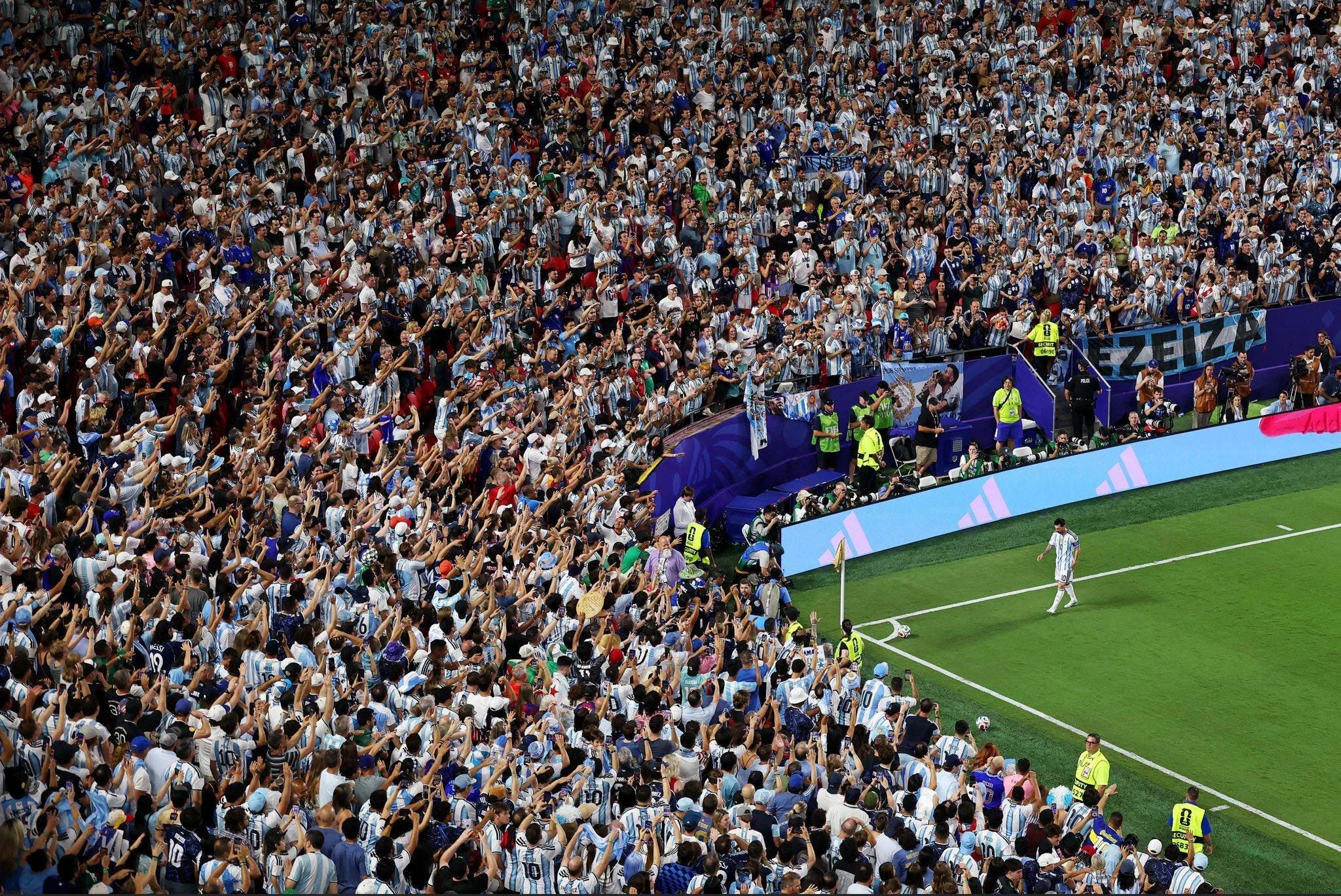
The 2026 World Cup final. Spain against Argentina, at MetLife, or New York New Jersey Stadium, as FIFA insisted we call it for the month. The objective for the players couldn’t be more obvious. Win the game. But there were lots of games being played. You just had to look.
The older fans were playing a game against time. A World Cup comes every four years, and at seventy you know how many you have left. Younger fans were playing a different game, living through the team, taking the result personally. Whole countries were playing too, treating eleven players as the nation itself for one afternoon. The veterans on the field were playing for legacy, for how they would be remembered once their legs were gone. Clubs were watching their assets. Agents sat in boxes. Market values moved while the ball moved.
And even the players were playing more than one game. You can’t tell me that Messi wasn’t thinking about the Golden Boot race with Mbappé, that the substitutes weren’t hoping for their moment, that players weren’t already thinking about the contract that comes next. Twenty-two players on the field and probably as many or more games.
There’s a phrase for part of this: the game within the game. Broadcasters use it to reference all kinds of subplots like historical or political factors behind the two teams or countries. Coaches use it to remind players about the importance of winning individual matchups, sticking with a game plan, executing set pieces, or managing the weather or the referee. All of these games within games have their own definition of success. Everyone in sport knows those games exist. We just underestimate how many are running at once, and how many are chosen for us and how many we get to choose.
Argentina came into the final scoring freely. Then, across two hours of football, they managed two shots, neither on target, and touched the ball eight times in the penalty area. They sat deep, kept bodies behind the ball and cleared it long. When they won possession, almost nobody joined the counter. Against Spain, this may have been the right plan. It nearly worked. Down to ten men, with Emiliano Martínez making save after save, Argentina came within minutes of penalties. They had chosen, or found themselves inside, a game of survival.
Then Spain sent on Ferran Torres.
In the 106th minute, Nico Williams headed a cross back across the area. Torres met it first time and beat Martínez before the goalkeeper could reset. Spain were world champions.
Asked about the moment afterward, Torres said he didn’t think too much. He saw the ball coming, and he hit it.
Then he ran, with no plan and no pose, mobbed by teammates, saying later that he didn’t know what was happening. I wrote recently about what goal celebrations have become, rehearsed routines performed for the cameras. This was the other kind. A real thing, happening once.
Watching all of this, I kept hearing a question my father used to ask me.
He is a retired philosophy professor, and when I was young he had a question he used whenever he suspected that what I said I wanted was not what I actually wanted. He would let me finish, wait a beat, and ask: What game are you playing?
His question was at first confusing, but over time I understood what he really meant. What is really going on? What counts as success? What are you really trying to accomplish? When I was thoughtful or courageous enough to answer him honestly, it was always useful and revealing. It puts the objective on the table, where you can finally look at it. The real shit, so to speak.
I have used this question ever since. On myself. On executives and athletes, for thirty years. I don’t know a more useful question.
Wittgenstein noticed that games share no single common feature, only overlapping resemblances, and used them to explain how language itself works. Goffman built a career on the claim that everyone entering a situation is silently asking what is going on here. Berne wrote a whole book about the games people play without ever choosing them. Carse split everything in two: finite games, played to win, and infinite games, played to keep the play going. My father handed me the question years before I could have named any of them.
We are always trying to accomplish something. Sometimes we know what it is. We walk into a negotiation knowing the result we want. We plan the hard conversation. We decide what kind of performance we are after.
More often, the choice has already been made for us. Fear chooses. Habit chooses. An old wound chooses. The first person to speak sometimes chooses for the whole room. By the time we notice, we are already following the rules. Naming the game doesn’t change it. But until it has a name, it stays in charge and you stay unaware.
At work, the games pile up. Get promoted. Stay safe through the next round of cuts. Lead my people well. Earn the paycheck and go home. Make a real difference. Each is legitimate. Each, though, directs us differently. One says stay quiet. Another says speak up. One says challenge the plan. Another says approve it and live to fight another day. What feels like indecision is often obedience to several games at once.
Public speaking is where I watch fear do the choosing most clearly. It creates real anxiety in almost everyone, including senior leaders who are unbothered by nearly everything else. Ask what game the anxious speaker is playing and the answer is almost always some version of safety. Don’t forget the words. Don’t sweat. Don’t embarrass yourself. Get through it. Every decision inside that game is a subtraction, one more thing not to risk, and the audience feels the shrinking without knowing what it is feeling.
Now hand the same person a different game. What is the most valuable thing these people could hear from you today? What would you say if you were trying to leave a mark instead of trying to leave the stage? The fear does not go away. It never goes away. What reverses is the direction of the effort. Instead of removing risk, you start adding value. It is the difference between Argentina’s whole afternoon and Torres’s one minute. I have witnessed this simple changing of the game transform a speaker in the time it takes to walk to the front of the room, and I use it on myself all the time.
More than once, thankfully earlier in my career, I sat across from a client with the thing he needed to hear clearly formed in my head, then delivered a smaller, safer version. I told myself I was being strategic. I was protecting the relationship. But really? I did not want to risk being disliked. I can play and win that game indefinitely. It isn’t what he was paying me for.
It took me years to find the game underneath that one. For most of my career I was playing outcome. Did the session land? Did the player improve? Did they think I was good? I tortured myself over it, mostly in private, because the scoreboard for this work lives inside other people, and you cannot read it. The angst was constant and a bastardized form of caring.
The shift came slowly, and not because I decided it in one sitting. Success moved from the outcome to the trying. From were they helped to did I bring everything I had to the attempt. I still care how it lands. I probably always will. But the game I can actually play, the only one whose score I control, is the pursuit. Changing that one game changed my work more than anything I ever learned. Pun intended, and earned the hard way: it was a game changer.
As parents, we want to prepare our children for the world. We want to protect them from it. We push because we believe they can do more, then pull back because we cannot bear to watch them hurt. And underneath those good intentions sits a quieter but insidious game, the one nobody says out loud: our children as proof of how we did, as reflections on us.
Watch a parent at a youth soccer match. Yes, sometimes the game is the child’s development. More often it seems like the child is playing in the parent’s private final. Trust me that your kid can tell the difference. I have stood on those sidelines (actually I would lie in three-quarter sweatpants by the corner flag) for two decades, for two sons, and I have not always been sure which game I was playing.
Once you can see the game, the harder question arrives: Is this the one I mean to play? The situation cannot answer that for you. Only identity can. The game worth playing is the one the person you intend to be would choose.
The answer is not always the bigger, braver, more enlightened game. Argentina’s plan nearly won a World Cup. There are rooms where the job is to be expedient, cut-throat even, give the information cleanly and sit down. There are years in a life when getting through the day is the entire assignment.
The ‘smaller’ game isn’t always failure. Letting fear choose it without your knowledge may be.
Ask it often. Before the pursuit, the endeavor, the meeting, the talk, the hard conversation. What am I actually trying to do here?
Then don’t accept your first answer. Maybe not your second. Dig and disturb your own universe of thinking. When the truth embarrasses you slightly, you are probably getting close. Decide whether to keep that game or choose another. Put the new one in a sentence plain enough to use. Give them the one thing they need to hear. Get us through this week. Find out what is true. Protect the relationship without hiding behind it. Then choose one action.
The speaker tells the story she removed. The player takes more risks. The parent stops coaching from the sideline. The adviser says the thing he knows he needs to say.
You do not need to feel ready or certain first. Conviction can arrive afterward.
This matters more now because we have machines that will answer almost anything we hand them. Tell one you are nervous about a presentation and want to get through it cleanly, and it will help you do exactly that, beautifully, in seconds. The machine returns the assignment finished and polished. It does not ask who assigned it.
It’s easy to win the wrong game. You’ve probably been doing it for years.
My father does not need to ask me anymore. It’s ingrained and now mine to pass on. Only lately have I understood that the question was his parenting game. He was not choosing for me. He was teaching me to notice that I had a choice.
What game are you playing? Choose wisely.